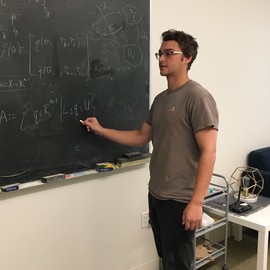
About me
Welcome! I am a Research Scientist at Basis, a non-profit research institute with offices in Cambridge, MA and New York, NY. My work focuses on improving the prediction and inference of biological and physical systems by blending machine learning, mechanistic modeling, and data assimilation techniques. I aim to build robust, unifying theory for these approaches, as well as develop concrete applications. I have worked substantially in the biomedical sciences, and enjoy collaborating on impactful applied projects. I am also an affiliate of the MIT Uncertainty Quantification group and Broad Institute’s Eric and Wendy Schmidt Center.
I am always interested in developing new collaborations. If you think our work is complementary, please send me a message!
Updates:
dynestyx (public version now available on PyPI) is a NumPyro-based library for Bayesian inference of dynamical systems (e.g., SSMs, SDEs, HMMs, etc.) from noisy, partial, and irregular time-series data. We decouple model specification from its inference and make advanced state-space methods easier to use in practice. We are excited for practitioners to try it on real problems, and for methodologists to critique, stress-test, and help develop the framework further.
Canonical Bayesian Linear System Identification: a new paper demonstrating (theory+examples) how to perform identifiable Bayesian system ID for noisy, partially-observed linear dynamical systems. It combines classical ideas from control theory and Bayesian inference, and was inspired by challenges faced when learning dynamical systems from data with uncertainty. Often, there are many symmetries (e.g., permutations/rotations of hidden variables) that make inference challenging and often wasteful—we directly solve this problem for linear dynamical systems, and hope these results can move us closer towards addressing the same challenge in non-linear Bayesian system ID.
CD_Dynamax: a new JAX repository for learning dynamical systems from irregularly sampled, partially observed, noisy time-series data (extends discrete-time state-space approach in Dynamax). Joint with Iñigo Urteaga at BCAM.
Interests
- Dynamical Systems
- Machine Learning
- Data Assimilation
- Biomedicine
Education
PhD in Computing + Mathematical Sciences, 2023
Caltech
BA in Biophysics, 2015
Columbia University